Is It Time to Rethink TMJ Surgery?
The temporomandibular joint (TMJ) is a rare orthopedic joint in the body that is not treated at a structural level when the injury is discovered. For the sake of comparison, an anterior cruciate ligament injury in the knee of a growing female is far more likely to be treated than a ligament injury in the TMJ of a growing female.
As a result, the TMJ is forced to adapt to the anatomic compromises that are unique to each patient. In patients with minimal anatomic compromises, adaptation occurs more frequently. These patients tend to do well with treatment options focused at the tooth level such as occlusal appliances which can change loading on injured TMJs but does not address soft tissue or hard tissue joint anatomy deficits.
Conversely, in patients who have significant anatomic compromises, the likelihood for adaptation decreases. Many of the typical TMJ treatment options such as occlusal appliances, physical therapy, behavior modification, etc., do not offer relief to problems that can significantly impact daily quality of life. When patients reach this point, they begin to seek other options and they may choose to do internet research about surgical options for injured jaw joints.
When patients Google “TMJ surgery” and read the websites, the common theme is never do TMJ surgery, or to consider surgery only as a last resort. This commonly held belief started in the 1970s and 1980s, when the reality was that TMJ surgery was unpredictable. Many patients had surgical treatment outcomes that made the problem worse. As a result, most practitioners and patients lost faith in TMJ surgery.
In retrospect, the issue was the inability to assess the risk involved in the procedure during treatment planning of the case. The ability to assess structural alterations in the TMJ from a soft tissue perspective using MRI and from a hard tissue perspective using CBCT did not exist in the 1970s and 1980s.
As a result of having to make treatment planning decisions based on indirect visualization of the anatomy, many well-intentioned procedures yielded less than optimal results. In most cases, the direct visualization of the anatomy revealed during surgery demonstrated anatomic deficits that were much greater than assumed from indirect visualization diagnostic modalities.
While TMJ problems were assumed to affect adults, it has become clear that the TMJ is injured earlier in life than previously suspected and earlier than other orthopedic joints in the body. The result of early injury to a growing TMJ can manifest in interrupted or arrested mandibular and maxillary growth.
The results of TMJ injuries that occur during the growing years can be a loss of mandibular and maxillary volume and projection impacting airway. If these injuries could be recognized and treated early, it may be possible to offer treatment options that are more conservative than orthognathic surgical procedures.
Zhu and co-authors recently published a study about “the effect of disc repositioning and post-operative functional splint for the treatment of anterior disc displacement in juvenile patients with Class II malocclusion.” The study shows how they repositioned discs in 28 injured TMJs in 14 patients (13 female/one male) with an average age of 16.7 years, and all patients were younger than 20.
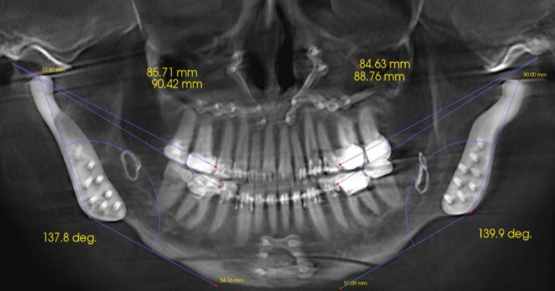
The discs were surgically repositioned and the post-operative, follow-up assessment was obtained at an average of 9.4 months. All 28 joints demonstrated new bone regeneration on the top and anterior-posterior condyle borders. The condylar height increased 1.74+/- 0.98 mm after the disc repositioning. The mandibles showed an average advancement of 3.62 mm.
From a patient’s perspective, the question must be asked if disc repositioning at an early age is more conservative than waiting until growth potential is ended and doing orthognathic surgery on perhaps unstable TMJs that may result in a relapsed surgical case. Zhu’s conclusion states, “Conservative treatment for anterior disk displacements with Class II malocclusion in juvenile patients may cause condyle resorption and aggravate the dentofacial deformity. Disc repositioning combined with post-operative functional splints can effectively promote condylar growth and help correct the dentofacial deformity.”
It is time to take a new look at joint surgery, specifically disc repositioning procedures. Zhu’s work follows Goncalves’ research in 2013, which showed bone apposition following disc repositioning.
If discs could be repositioned during the developmental years — resulting in increased condylar height and increased mandibular projection — the impact on patients would be extremely significant in terms of fewer malocclusions, less pain, and less airway impingement.
References
- Zhu, H., He, D., Yang, Z., Song, X., & Ellis III, E. (2019). The effect of disc repositioning and post-operative functional splint for the treatment of anterior disc displacement in juvenile patients with Class II malocclusion. Journal of Cranio-Maxillofacial Surgery, 47(1), 66-72.
- Goncalves, J. R., Wolford, L. M., Cassano, D. S., Da Porciuncula, G., Paniagua, B., & Cevidanes, L. H. (2013). Temporomandibular joint condylar changes following maxillomandibular advancement and articular disc repositioning. Journal of Oral and Maxillofacial Surgery, 71(10), 1759-e1.
SPEAR campus
Hands-On Learning in Spear Workshops
With enhanced safety and sterilization measures in place, the Spear Campus is now reopened for hands-on clinical CE workshops. As you consider a trip to Scottsdale, please visit our campus page for more details, including information on instructors, CE curricula and dates that will work for your schedule.

By: Jim McKee
Date: August 15, 2019
Featured Digest articles
Insights and advice from Spear Faculty and industry experts