Using a Hybrid Dental Schedule to Increase Production for Today and Tomorrow
Creating an ideal dental schedule is tough because you want to maximize production while avoiding chaos and an exhausted team. You are also constantly thinking about future production. How many new treatment plans do I need this month to reach my goals?
Ideals are great, but they can be hard to measure and track. I like to create an engineered schedule using the Hybrid Dental Scheduling Method. This method frees you from vague rules about scheduling because it focuses on hard numbers, which provide clear direction for creating a fully optimized schedule.

Hybrid scheduling is a combination of three core scheduling methods:
- Block Scheduling
- Staggered Scheduling
- The Theory of Constraints
These are used to help create a schedule with three core characteristics:
- Maximizes profitability (not production) per unit time
- Allows the day to flow in a steady manner when the schedule is built around your tightest constraint
- Creates enough new treatment plans so that next month can be as profitable as this month.
To reach these goals and implement the tactics, we will need to understand the strategy behind The Hybrid Dental Schedule Method.
1. Block Scheduling
You may be familiar with this strategy or even use it already. On its most basic level, it assumes that your most productive procedures will need a long, continuous stretch of time.
This is where pre-blocking comes into play. You want to allow time for these longer appointments, but you do not know when they will need to be scheduled. If you pre-block, you can reserve larger openings for high-production procedures.
This also works for new patient appointments. Your average new patient typically has a larger treatment plan than an existing patient. If you have a complete recall schedule but do not allow time for new patients, you could run into a problem. These new patients with potentially larger treatment plans will go to another office if they cannot get in quickly. By pre-blocking, you can get new patients in quickly to help increase your scheduling availability for new treatment plans.
2. Staggered Scheduling
This form of scheduling is less commonly discussed, but it’s just as important. In each dental appointment, multiple resources need to be used at various times. For example, during the start of a filling appointment, the patient will be seated, and a topical will be placed. The doctor is not needed yet, but the assistant and the operatory are being used. When planning out a schedule, you never want to double-book a resource.
In most cases, the doctor’s time will be your tightest constraint in a busy, multi-chair office. The goal is to plan a schedule allowing the doctor to bounce from room to room, busy but not rushed. This way, the practice can make more money today and prevent the doctor from burning out, leading to better production in the long term.
3. The Theory of Constraints
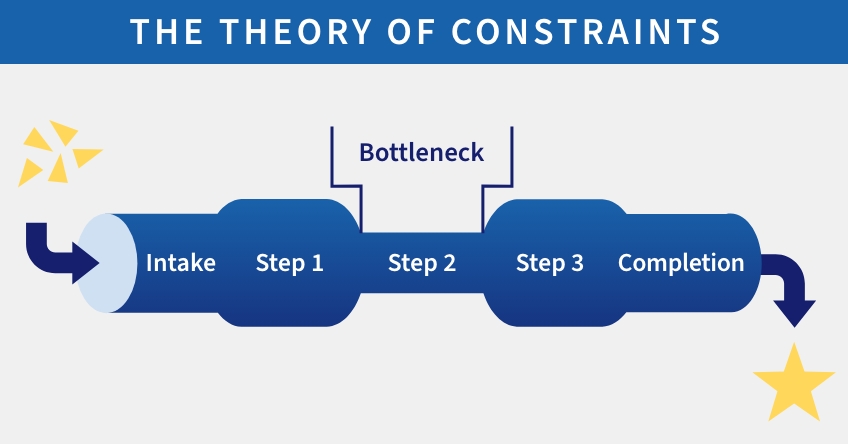
This might be an unfamiliar concept, but it has been taught in business and MBA programs for decades. It allows manufacturing facilities to generate more revenue without overworking their employees. There are layers to the Theory of Constraints, but there are a few key bullet points that relate to dental scheduling:
- Your business is a series of dependent events. This means that the output of one segment is the input for the next.
- Because these events are so interlinked, the final output will be controlled by the tightest bottleneck in the chain.
- If you try to fix an area that is not the real bottleneck, you will not increase the final output (collections), or you might even increase overhead, which will decrease profitability.
Think of it as a series of pipes with water flowing from one to the next. The water will exit one pipe and enter the next one. If one pipe is too small, it will control the flow rate of the entire system, regardless of where it is positioned. If you replace a pipe that is not the bottleneck with a larger pipe, you will not increase the flow rate but will increase the weight of the system.
The Hybrid Dental Schedule
Now that we have the basic groundwork for the strategy, let’s move on to tactics. The first step is to identify our most productive procedures per unit time. You will need the following pieces of information:
- Procedure List
- Material Cost (for each procedure)
- Times Tables (for each procedure)
- Cost Per Production Hour
- Reimbursement Rate (for these procedures)
- Rank Order (list of these procedures based on profitability per unit time)
1. Procedure List
After creating this list, you can see which procedures profit most and reshape your schedule to maximize profitability. When creating your procedures list, you do not need to separate every little procedure. Clumping procedures together, like a single filling, quadrant filling, and half-mouth filling, will be fine.
2. Material Cost
For the material cost, you also want to consider all consumable materials and lab fees related to the procedures. This will include items needed to turn over the room, like cavi wipes and gloves. Some materials, like impression material, will be harder to calculate. You can estimate these, or you can weigh the tubes before and after use to determine the amount of material used.
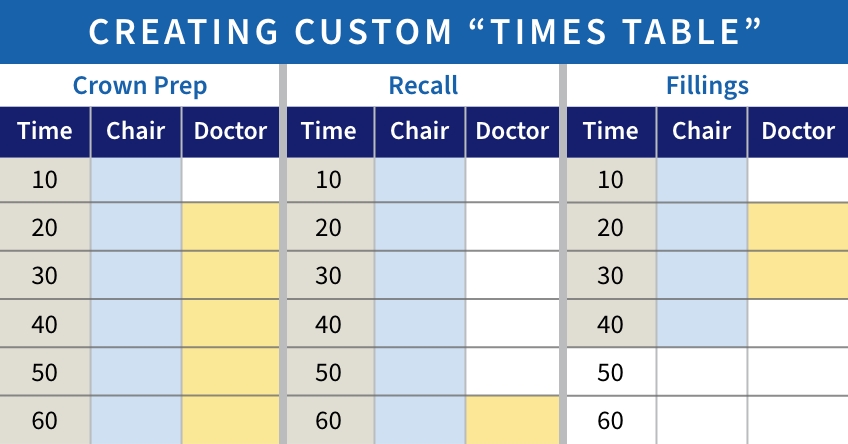
3. Times Tables
“Times Tables” are a chart I created to help others understand when your constrained resources are being used for the procedure. These tables show the entire procedure time and when the doctor is needed.
4. Cost Per Production Hour
This is calculated by finding the total cost to run your business per month minus dental material and lab costs. Then, divide this total monthly cost by the total number of hours you are open each month. This gives you the actual cost of being open each hour.
In a dental office, there are typically two major constraints, doctor time and chair time:
- In a doctor-constrained office, divide your cost per production hour by the number of doctors. When calculating a procedure cost, you will count the number of doctor time units needed to calculate your time cost.
- In a chair-constrained office, divide the total cost by the number of chairs in the office to find the cost per unit of time. Then, count the number of units of chair time to calculate the cost of providing a procedure.
5. Reimbursement Rate for Procedures
All you need to do for this is add up the expected collection for the procedures you clumped together in your timetable. You may also want to determine how much you would collect for a cash patient, an average PPO, and your lowest-paying PPO. This will show whether you might be losing money during some procedures.
6. Creating Your Rank Order List
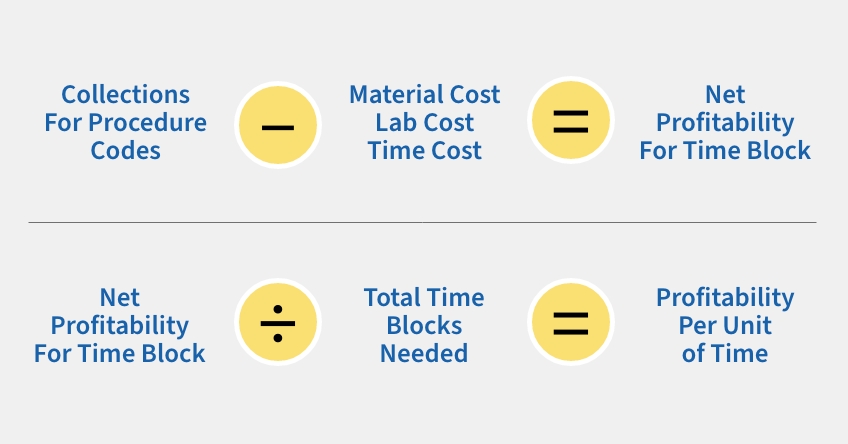
Now that we have a list of all our procedures, their material and time costs, and reimbursement rates, we can find each procedure’s net profitability per unit time and rank them from high to low. You might be surprised how much profit you see with some procedures and how little you see with others.
Take the total expected collection for a procedure and subtract your material, lab, and time costs to find your net profitability.
You will find that exam and consult appointments are not the most profitable thing on your list—but they are necessary to initiate new treatment plans and set up next month’s production.
Creating Production Goals
While creating your Hybrid Dental Schedule, you want to also keep an eye on your production goals and new treatment plan creation to ensure that future months are as profitable as the current month.
Also, consider your conversion rate, just because you recommended a treatment plan does not mean the patient will follow through to get the work done.
Set a production goal, then set a treatment plan goal based on your production goal and your conversion percentage. You can consistently reach your production goals if you generate enough treatment plans each month.
You now have all the tools you need to create a hybrid dental schedule. Pre-block your schedule with your most profitable procedure. Stagger appointments so you are not choked off by your tightest constraint. Lastly, make sure you initiate enough new treatment plans this month to allow you to reach your production goals next month.
SPEAR NAVIGATOR
Transform how your practice runs by engaging the team through
coaching and training
A guided path to excellence through structured coaching and self-guided resources that will align your team, streamline processes and drive growth. Transform your practice by implementing Spear’s proven playbooks for developing and retaining a high-performing dental team.

By: Michael Arias
Date: October 18, 2022
Featured Digest articles
Insights and advice from Spear Faculty and industry experts