Owning a Private Practice in the DSO World

As the owner of a private practice, I wanted to share my perspective on ownership and its relationship to the future of dentistry.
Over the past two decades, most dentists have seen a proliferation of dental support organizations around them, and many have even felt the impact of that. Most articles on the future of dentistry are doom-and-gloom ones, letting us know a single-practice owner is going to be pushed aside by corporate and large group practices.
One such article that spurred quite a discussion between my local dental colleagues was “The Future Doesn’t Care” by Dr. Marc Cooper.1 Contrary to what many articles (and even individuals of influence, such as deans of dental schools) suggest about the future, I want young and future dentists like my brother, who’s in his first year of dental school at UPenn, to realize that dentistry is a rewarding career and ownership of a dental practice is an achievable goal.
Consolidation in dentistry
Businesses consolidate through acquisitions or mergers with other businesses for survival or to allow for growth. Consolidation happens across all industries, including medicine and dentistry.
Medicine has gone through two phases of physician consolidation. The first phase began in the 1990s as management service organizations, but many MSOs dissolved by the early 2000s.2
The current phase is vertical consolidation as hospitals buy private practices and employ physicians. Employment versus practice ownership is attractive for many reasons, including income security in light of decreasing reimbursements and increased practice operational costs, potentially less stressful work environments, fewer administrative responsibilities, and a need to belong to an organization for increased market power.2
These same reasons apply to the dental field and are compounded by staggering educational debts, the increased cost of initial practice ownership, and the need for young dentists to gain clinical experience. This consolidation has been happening over the past two decades.
Employment statistics over time
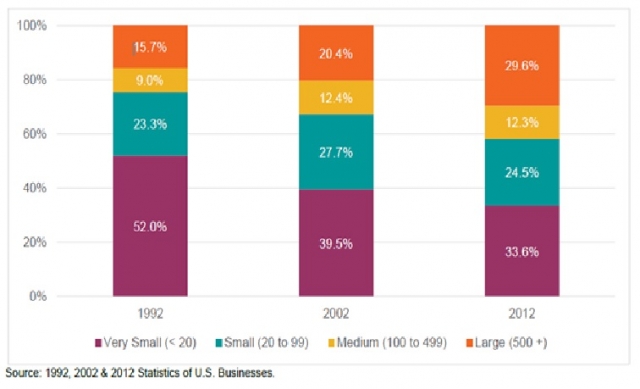
Fig. 1 shows the percentage of physician office staff employed and how large physician offices increased the number of employees from 15.7% in 1992 to 29.6% in 2012, whereas very small physician offices decreased from 52% in 1992 to 33.6% in 2012.2
Fig. 2 shows the percentage of dental office staff employed and how large dental offices increased employees from 0.5% in 1992 to 3.9% in 2012, whereas very small dental offices decreased from 89.3% in 1992 to 80.7% in 2012.
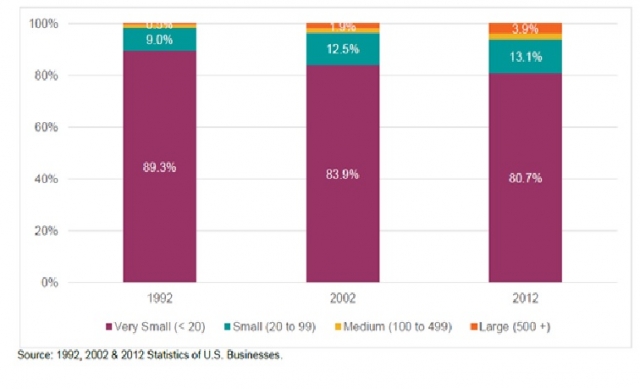
Consolidation is done mainly for two reasons. The first reason is survival, as larger entities overrun small ones. The second reason is better margins and increased profits. For these reasons, DSOs have had success in market penetration. Dental firms with 20 employees or more have increased in market share, while very small firms have declined from 2002 to 2012.3 Very large dental firms during that time saw increases across the board. Table 1 depicts market share from 2002 to 2012.3
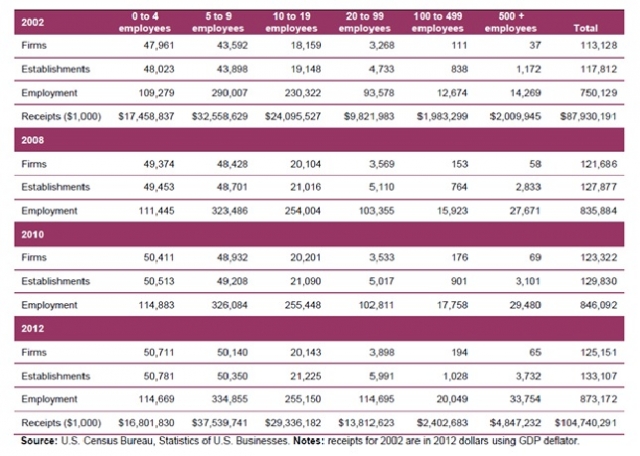
Many statistics point to consolidation, but dentistry will find its own equilibrium that is different from what we see in medicine. Unlike dentistry, medicine has a central hub — the hospital — so vertical integration has become quite successful. The results presented above depict growth in the size of all dental practices, but small practice ownership still dominates the dental sector.
Physicians’ offices are typically concentrated around hospitals, while dental offices coincide with the patient’s location. This dispersal of practices allows dentists to build and maintain strong, long-lasting relationships with patients. Large practices and the DSO model are a growing segment in the dental marketplace, but the market is still primarily dominated by the small practices (19 or fewer employees).
The key to successful ownership
My practice is one of these small practices. I began with three employees and, with increased revenue and demand, have grown to five employees, seeking a sixth. The practice was modestly grossing $600,000 a year before my purchase as a first-time owner. In the past two years, I’ve increased production by just over 20% year over year. Despite the daunting fact that my practice is in one of the most highly saturated areas in my state for dentist per capita, we have seen great success.
This dental practice growth was not due to luck or an improving economy; this growth was centered around a dental vision and shaping a culture of growth within the practice. I have attained strong bonds with my patients that not only make them feel comfortable but encourage them to invite their friends and family to the practice.
All of my practice-owning local colleagues’ responses to Dr. Marc Cooper’s article mentioned above were that dentists who have a vision and pursue it with vigor can and will become successful. Take the continuing education courses that will help solidify your vision and invigorate you — don’t just take the ones that give the free dinner so you can meet your state requirements.
Those practices with vision continue to grow year after year. Become the cosmetic specialist, implantologist, or CEREC guy or gal in your community, as opposed to the owners who “just do it all” and may slowly grow or sustain in this competitive environment.
So to the young dentist and future dentist and to my brother: Find your passion within dentistry, formulate your vision into words, and pursue it with vigor. Ownership can be not only achievable but also a successful and rewarding venture.
References
- Cooper, C. L. (2005). The future of work: Careers, stress and well‐being. Career Development International, 10(5), 396-399.
- Guay, A., & Wall, T. (2016). Considering large group practices as a vehicle for consolidation in dentistry. Health Policy Institute. American Dental Association.
- Wall, T., & Guay, A. H. (2015). Very large dental practices seeing significant growth in market share. Health Policy Institute Research Brief. Chicago: American Dental Association.
SPEAR NAVIGATOR
Transform how your practice runs by engaging the team through
coaching and training
A guided path to excellence through structured coaching and self-guided resources that will align your team, streamline processes and drive growth. Transform your practice by implementing Spear’s proven playbooks for developing and retaining a high-performing dental team.

By: Puneet Sandhu
Date: April 26, 2017
Featured Digest articles
Insights and advice from Spear Faculty and industry experts