Selecting the Right Provisional Cement
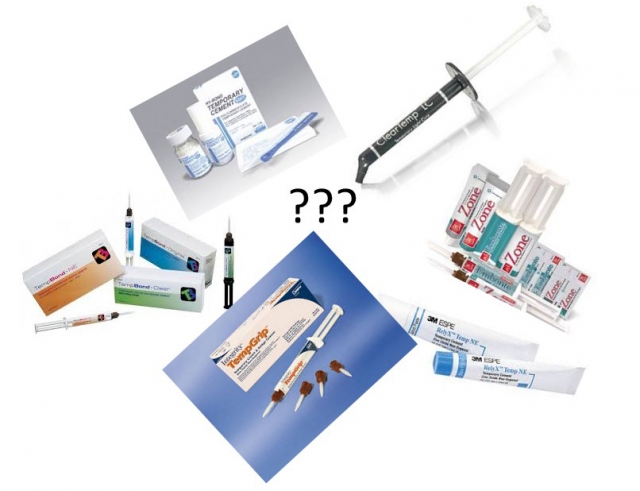
Once you have a patient’s teeth prepared, the impressions done, and nicely trimmed and polished provisionals ready for delivery, it’s time for cementation of your provisional. But, what do you use and why? We often use one cement for cementing our provisionals and rarely vary from it unless the provisional keeps coming off. Sound familiar?
Provisional cementation can and does affect the overall outcome of the patient’s overall experience as well as the outcome of final restoration. Not only does it protect the prepared tooth from bacteria and thermal insults, it also keeps the provisional in place and helps stabilize the position until the final restoration is placed. Thus, it plays an important role in overall treatment success and, ultimately, the patient’s perception of your abilities as a clinician and your practice as a whole.
In this article, I will review some thoughts to ponder when we cement and why we can and should use different provisional cements.
Which provisional cement do you use?
When selecting provisional cements, here’s a list of questions or thoughts on how to select the right provisional cement for you and your patient:
Does the tooth preparation have adequate retention/resistance form?
If the tooth preparation is really short or tapered and the provisional comes on and off easily, then we have to rely on the cement more to help retain the provisional between preparation time and delivery. If it’s a tooth that has a really long preparation — such as situations in which we are preparing periodontally involved teeth or a tooth that has a lot of mechanical retention, such as an inlay or onlay preparation — then we can use a cement that has minimum retentive properties. If we have multiple teeth splinted together versus a single unit, this can increase retentive properties as well. In the anterior segment, we have to consider minimum prepared teeth such as veneers that have little to no retention at all.
(Click this link to learn more about outcome-based preparation design.)
How long is the patient going to wear the provisional, and are they going to be readily available?
If the patient is doing phased treatment or is traveling out of town and can’t come in readily, we need the provisional cement to last longer and be more durable, to help keep our provisionals in place and the preparations sealed up. On the other hand, when we’re seeing a patient back sooner than later, this can impact using a cement that is readily retrievable. In some cases where dentin bonding will be involved, we have to consider the provisional cement and how it may or may not impact the final cementation.
Which teeth are we working on, and will the provisional cement be readily seen?
When we work on the anterior segment of teeth that are a part of the patient’s smile, especially if we’re doing conservative restorations, we have to remember that many provisional cements are opaque in nature and will readily show through the provisionals. This will negatively affect the esthetics during the important provisionalization phase.
Categories of provisional cements
So, which cements are available for us to use to cement our provisional? Well, at one time and point, we had but a few to choose from; however, as with so many things, we now have a lot of options and brand names from which to choose. Despite so many options and the confusion that comes along with them, they still fall into the following four main categories of cements:
Zinc oxide with eugenol (ZOE) cements
Zinc oxide with eugenol cements have been around a long time and have a proven track record. They also contain eugenol, an agent that’s very effective at sedating the pulp and keeping prepared teeth from being sensitive. ZOE cements also are antimicrobial in nature. Some examples of this type of cement are Temp Bond, Rely X Temp E, and Fynal. However, over the past decade or so, there has been concern over free eugenol and its effect on dentin bonding and softening of resi, because of its impact on polymerization and the final cementation strength and success. Some studies1,2 show that if the provisional restoration and cement containing eugenol is left for a period of seven days or greater, the free eugenol that affects resins and bonding has been fully incorporated in the zinc oxide and, thus, has little to no effect on the final cementation/luting with resin-based cements. With that being said, and considering the controversy and concern associated with it, this led to the development of cements without any eugenol present.
Zinc oxide without eugenol (ZONE) cements
As their name describes, these cements are basically the original ZOE cements without eugenol, or “eugenol-free.” Early on, many of these cements did not set as hard as the original ZOE cements and retention of provisionals was an issue. However, over the years, the formulas have improved and retention strength is as good as, if not better than, some of the older ZOE cements through the addition of a polycarboxylate component. They have great retention and there is no worry of interfering with final cementation, but without eugenol, these cements have no sedating effect or desensitizing effect on the tooth or pulp. Examples include Temp-Grip, Temp-Bond NE, and Zone.
Polycarboxylate cements
Polycarboxylate cements have been around for some time and have been used for “permanent” cementation of final restorations. They adhere well to the tooth and offer very good retention of provisionals, as well as minimizing postoperatory sensitivity, secondary to their ability to create an excellent seal. Some examples of polycarboxylate temporary cements are Cling2 and Hy-Bond, but Durelon, a “permanent”-type polycarbolxylate, has been used with excellent results as well. The main issue with these cements is that they can be difficult to remove from the tooth itself.
Resin-based cements
The most recent class of temporary cements is resin-based. They offer excellent retention and better overall esthetics because they’re offered in a clear color base (thus minimizing any effect on the provisional shade), and they can be easy to clean up. However, one of the main issues with this classification of cements is microleakage under the provisional, leading to a black discoloration from the invading bacteria as well as sensitivity. And, because they are resin-based, some will inadvertently adhere to some core materials, making them very difficult to remove. (One tip that can help with the sensitivity and black discoloration is by placing a desensitizer such as Gluma, which has HEMA in it and is a very effective antimicrobial and desensitizer.) Some examples of these are Temp-Bond Clear, NexTemp, and Telio CS Link. Many newer resin cements are adding potassium nitrate as well as chlorohexidine to help combat the microleakage and sensitivity issues.
When it comes to provisional cementation, first and foremost, we have to look at the individual situation and tooth/teeth involved. Then, based on that information, we can look at the different cements that are available and make a choice that will be best for our patients and their individual situations.
References
- Peutzfeldt A, Asmussen E. Influence of eugenol-containing temporary cement on efficacy of dentin-bonding systems. Eur J Oral Sci European Journal of Oral Sciences. 1999; 107(1):65–69.
- Silva JPL, Queiroz DM, Azevedo LH, et al. Effect of eugenol exposure time and post-removal delay on the bond strength of a self-etching adhesive to dentin. Operative Dentistry. 2011; 36(1):66–71.
VIRTUAL SEMINARS
The Campus CE Experience
– Online, Anywhere
Spear Virtual Seminars give you versatility to refine your clinical skills following the same lessons that you would at the Spear Campus in Scottsdale — but from anywhere, as a safe online alternative to large-attendance campus events. Ask an advisor how your practice can take advantage of this new CE option.

By: Jeff Lineberry
Date: March 9, 2016
Featured Digest articles
Insights and advice from Spear Faculty and industry experts