Maxillary Prosthesis Retained by Two Dental Implants
Two dental implants retaining a lower denture have greatly impacted our edentulous patients’ confidence in a social setting and overall quality of life.
The McGill Consensus Statement from May 2002 recommends a mandibular overdenture retained by two dental implants as the first-choice standard of care for edentulous patients. The question remains: Is it fair to assume that what has been successful and recommended treatment for the mandibular arch will work for the maxillary arch?
This patient presents for an evaluation with two dental implants placed in the anterior segment of the maxilla and mandible. She had been wearing complete upper and lower dentures that had been made before the placement of the dental implants.
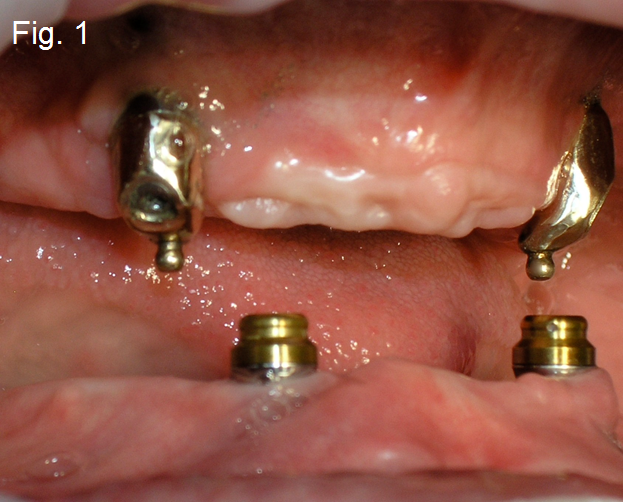
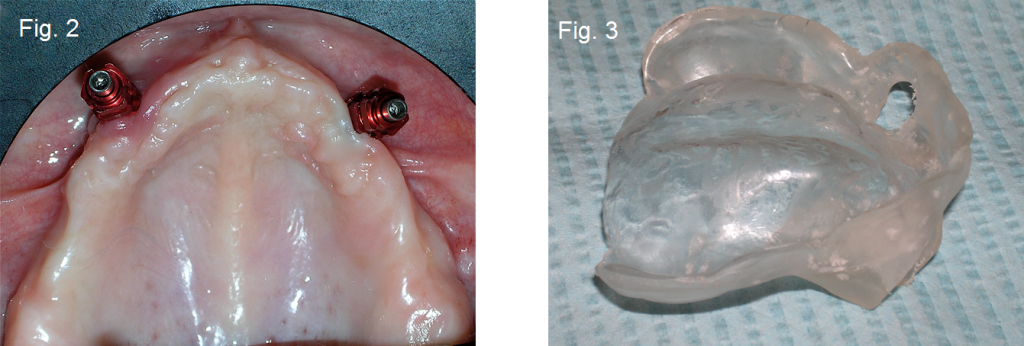
The patient was aware that additional dental implants in the maxilla would require augmentation/bone grafting and did not wish to proceed in that manner. While the lower dental implants can be placed parallel and perpendicular to the occlusal plane, the resorption patterns typically result in a less-than-ideal position for the maxillary dental implants (Fig. 1). The impression technique requires the attention to detail required of traditional complete dentures, using the attachments as supplemental retention (Figs. 2 and 3).
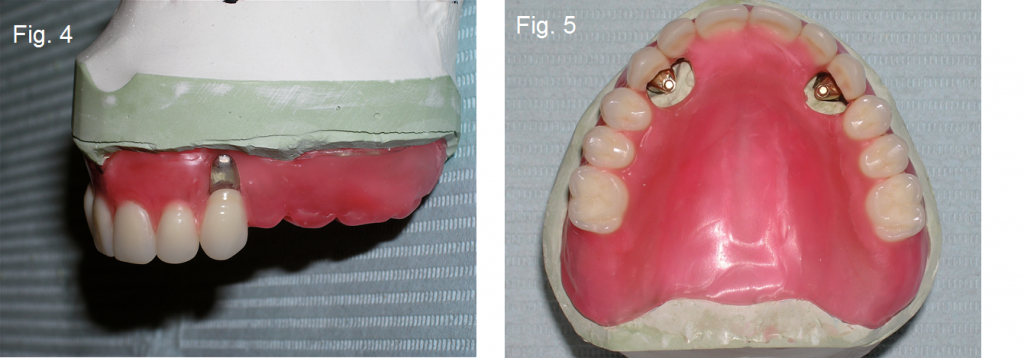
Once the working cast is made, the anatomic determinants of tooth position are identified and verified with a trial in wax, allowing for the custom abutment to be made within the confines of the prosthesis (Figs. 4 and 5).
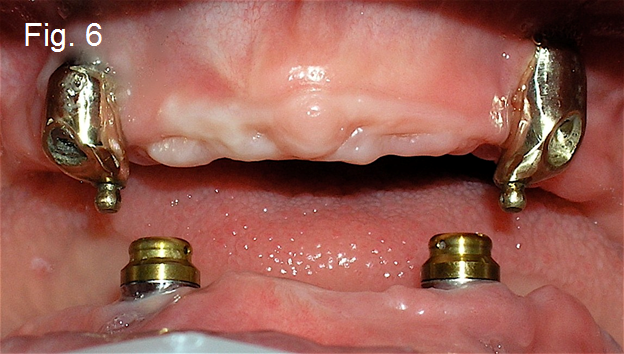
The ball-O-ring attachment allows for slight movement of the overdenture. It is self-cleansing and, to some extent, does not require parallel placement of the dental implants (Fig. 6).
The definitive prosthesis’s design includes full coverage of the palate in Vitallium to provide retention and stiffness (Fig. 7).
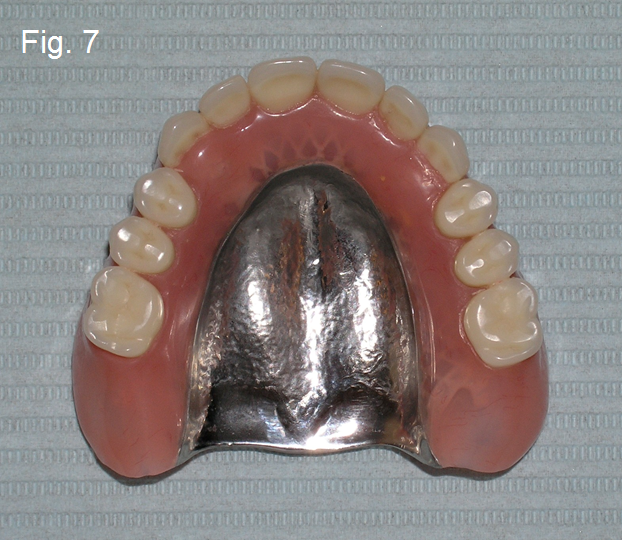
The alloy limits the torsional forces (as compared to acrylic only) applied to the dental implants during function as well as during insertion and removal.
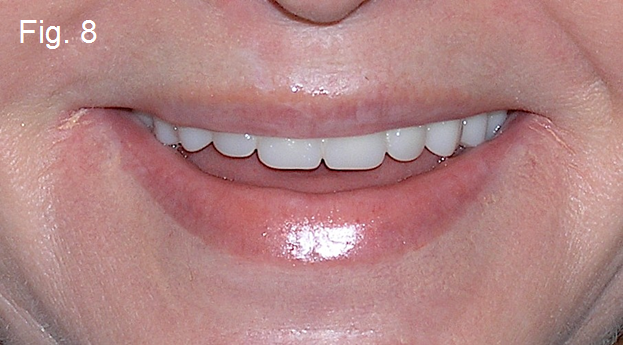
A discussion with the patient regarding the compromised nature of the design, where the forces involved with normal function may result in the breakdown of the supporting structures of the maxillary dental implants and associated components at some point in the future. This means that the attachments would likely be changed in shorter intervals. Maintenance may require either a reline or a remake of the prostheses and/or abutments to optimize the distribution of forces to the dental implants (Fig. 8).
Two implants in the maxilla appear to be a dental treatment alternative with increased maintenance, with a few more steps in the treatment sequence for our edentulous patients. The favorable dental treatment described by Eckert (2004) and others (four to six dental implants in the maxilla) may require extensive augmentation of the supporting structures. Many patients may be unable to proceed with an ideal plan due to concerns related to overall health and healing capacity or simply financial resources.
References
- Feine, J. S. (2002). The McGill consensus statement on overdentures. International Journal of Prosthodontics, 15, 413-414.
- Eckert, S. E., & Carr, A. B. (2004). Implant-retained maxillary overdentures. Dental Clinics, 48(3), 585-601.
SPEAR STUDY CLUB
Join a Club and Unite with
Like-Minded Peers
In virtual meetings or in-person, Study Club encourages collaboration on exclusive, real-world cases supported by curriculum from the industry leader in dental CE. Find the club closest to you today!

By: Doug Benting
Date: June 1, 2017
Featured Digest articles
Insights and advice from Spear Faculty and industry experts