Dentin Adhesives for Direct Posterior Composite
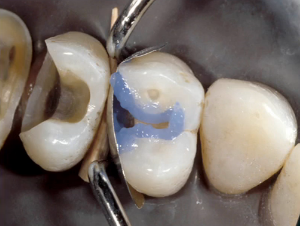
Direct composites represent an ever-increasing percentage of procedures in the 21st-century dental office. In fact, they represent a procedure that restorative dentists do in their practice on a daily basis.
In spite of the frequency with which they’re performed, they can occasionally be problematic because of tooth sensitivity after treatment. This sensitivity can be caused by pulpal inflammation, but in most instances I believe it’s from inadequate sealing of the dentin.
Dr. Martin Branstrom taught us years ago that open dentinal tubules lie at the heart of sensitivity, and eliminating sensitivity requires the tubules be sealed. Many products are capable of this, but two approaches that have been very effective for me have involved either a self-etching two-step system, such as Clearfil SE bond, or a total-etch two-step system, such as 3M single bond.
Here are the steps I follow to eliminate sensitivity and obtain an adequate bond to enamel and dentin, recognizing that others may use different products and techniques and get excellent results as well.
Steps for a great bond without sensitivity
Etch enamel
Whenever I use a self-etch, two-step product in the posterior, I etch the enamel first to ensure a good bond to it. I know several friends who don’t pre-etch the enamel with self-etching systems and have great success, but I still prefer a 15-second enamel pre-etch. If some acid gets on the dentin — which it will — I’m not overly concerned about it. With the total-etch, two-step systems, I etch the enamel and dentin for 15 seconds. For either system, the acid is then rinsed off and the tooth lightly dried.
Apply desensitizer
Since 1987, I’ve used Gluma desensitizer after etching and before applying dentin adhesive. Gluma, which contains 5% glutaraldehyde and 35% HEMA, has been shown to disinfect the preparation and coagulate proteins in the dentinal tubules, which slows down the flow of fluid in the tubules reducing sensitivity. Bottom line for me is that it has been incredibly successful at eliminating most postoperative sensitivity. There’s some question whether it is necessary with self-etching dentin adhesives, but I choose to use it because of the results I get. I lightly dry the Gluma before applying the dentin adhesive; others leave it wet with success as well.
Apply dentin adhesive
I then apply the dentin adhesive according the manufacturer’s instructions. It’s important to make sure the adhesive dries properly and all of the solvent is thoroughly vaporized. In my experience, the typical water/air syringe does not produce clean, dry air; I like using an Adec air-drying unit that attaches to a four-hole handpiece hose to ensure the area is dried without contamination.
The one thing I’m very aware of is that different adhesives must be applied with different protocols, and often dentists don’t read the instructions as to how to apply the adhesive, whether to agitate it or not, number of layers, etc. Whatever product you use, definitely follow the manufacturers instructions for application. After drying, the dentin adhesive is light-cured.
Verify adequate coverage
After light-curing the bonding agent, it’s essential to verify adequate coverage. A tooth that is adequately covered will have a shiny surface all over the dentin; if you don’t see any shine, apply another layer of adhesive on top and repeat the process of drying and light-curing until it yields the results you want. Remember, we have to seal the tubules to prevent postoperative sensitivity.
Place first layer of composite
There is ample evidence that bulk-filling techniques are successful — and with the newer low-shrink materials, likely even better then ever — but I personally like to use incremental placement. I start off by placing the composite along the buccal and lingual walls of the proximal box, extending up and along the buccal and lingual walls of the occlusal as well (essentially leaving the middle of the prep unfilled). This layer is cured completely before the second increment.
Place second layer of composite and cure
The second increment fills up the center, but I don’t place the composite all the way to the top. If desired, I’ll add a little colorant to the top of this layer to give the composite a more natural appearance, and again cure completely before the final increment. At that point, I place the final increment of composite and build it up to the correct contour for proper shaping.
I recognize there are more products and techniques available for placing direct posterior restorations than we’ve ever had in dentistry, many which are very successful. But hopefully the recipe I presented may help you if you’re having sensitivity problems with your direct composites.
FOUNDATIONS MEMBERSHIP
New Dentist?
This Program Is Just for You!
Spear’s Foundations membership is specifically for dentists in their first 0–5 years of practice. For less than you charge for one crown, get a full year of training that applies to your daily work, including guidance from trusted faculty and support from a community of peers — all for only $599 a year.

By: Frank Spear
Date: February 12, 2018
Featured Digest articles
Insights and advice from Spear Faculty and industry experts