Return on Investment in the Dental Practice
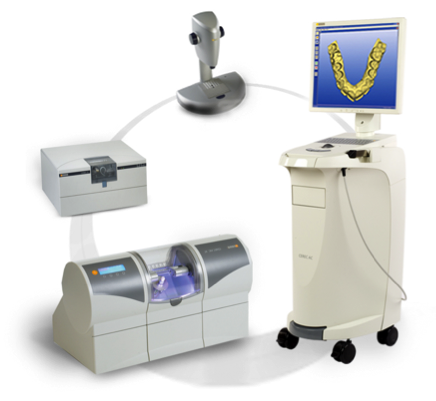
Incorporating CEREC into your practice doesn’t eliminate lab fees, but it does make good economic sense. Let’s look at the numbers.
I was with a group of doctors recently on the Spear campus for an Occlusion in Clinical Practice workshop and we were working in one of the operatories. As you may be aware, in addition to the Spear hands-on workshops held here, CDOCS also offers courses on the use and implementation of CEREC CAD-CAM technology into the practice.
We have many CEREC machines in the lab and clinic. With so many around, it’s hard not to have some conversation about them regardless of the course. I found a recent comment particularly interesting: “I’m not going to buy that thing. They try to sell it to you by implying that you can eliminate lab costs, and that’s a lie — you just pay them, and it’s more than you would pay the lab. What a rip.”
Before I talk about my reply, I’d like to take a business moment, not something most of us were well-trained for. Return on investment (ROI) is a foundational principle in business; failure to pay attention to this reduces the profitability of the business and robs owners and employees of income and of opportunities to reinvest in the business.
Understanding variable expenses and unit costs
When I speak with owners of CEREC machines, I occasionally hear the statement “I eliminated my lab cost” as one of the reasons for acquiring the technology and investing in learning how to use it well. That statement is technically correct; you aren’t sending a check to your technician for that restoration. But it is financially incorrect; the cost has not been eliminated, it has been shifted.
Checks written to the technician are a variable expense. The amount varies depending on the number of units completed; it’s a per-unit cost. Complete one unit and your lab cost is X, complete 100 and it’s 100X.
When you invest in a CEREC machine, parts of that variable expense remain: the cost of the blocks, the diamond burs, and the machine maintenance. For our discussion, let’s say the block is $30, burs $10, and powder and distilled water $2, for a total of $42 per unit. (I’ve left out the costs of increased chair time and the potential for increased doctor time depending on how you complete design and fabrication, as well as the savings on impression materials, so we can do an easy example.)
The cost of using the machine to the business is a variable expense — it will increase (vary) as the use of the machine increases.
The cost of having the CEREC machine and the subscription plan is a fixed expense: It will remain the same even if the use of the machine increases. When you do more dentistry, your fixed expenses are reduced as a percentage of the whole, while your variable expenses rise as a percentage of that whole.
Doing the math
If your CEREC machine payment is $2,000 per month and you do one unit with it, the cost of that unit of dentistry is equal to 100% of the variable expense ($42) and 100% of the fixed expense, for a total “lab fee” of $2,042 ($42 + $2,000) for that unit.
The second unit you do that month changes the cost for each unit to $42 + $1,000 (50% of the fixed expense) for a unit total of $1,042. Do 20 units and it’s $42 + $100 (5% of the fixed expense) for $142; do 40 units and … well, you can do the arithmetic. Pay off the machine and the only fixed expense to add to your variable expense is the subscription plan, divided by the total number of units. When you upgrade to the BlueCam, like most of us did, we start the process over again.
What does this mean for you and your practice?
It’s this calculation that determines whether a CAD-CAM system makes sense for your office. If you’re not going to do enough with it to bring the unit fee equal to or less than the lab fee for your technician, it may not make sense, and I’ve seen some people come to that conclusion.
This very simple example does not consider the benefits of single-appointment dentistry or the impression of being state-of-the-art that comes with CAD-CAM dentistry in the office. It’s meant to help you see that ROI can only be calculated when you understand and apply some general accounting principals to your consideration.
The CEREC machine does not eliminate “lab fees”! What it does is create a situation in which you have the tools in place to reduce the lab fee per unit, as you make use of the machine by shifting part of the lab fee to a fixed expense that is reduced over time as the debt is retired and the machine depreciated. I love having and using mine!
VIRTUAL SEMINARS
The Campus CE Experience
– Online, Anywhere
Spear Virtual Seminars give you versatility to refine your clinical skills following the same lessons that you would at the Spear Campus in Scottsdale — but from anywhere, as a safe online alternative to large-attendance campus events. Ask an advisor how your practice can take advantage of this new CE option.

By: Gary DeWood
Date: April 20, 2017
Featured Digest articles
Insights and advice from Spear Faculty and industry experts